
Starting a Contra Costa County Resident Search
Contra Costa County is a countywide records system, not one municipal resident list. Martinez is the county seat and the physical hub for the Clerk-Recorder, Assessor, and court records, while the county's 19 incorporated cities and unincorporated communities create their own permit, code, civic, and local-history trails. The right first source depends on the fact in hand. A known parcel points to the Assessor and GIS. A full name may lead to a recorded document, court index, license, or business filing. A past household belongs in directories, census schedules, newspapers, and library collections.
Each source answers a narrower question. An assessment record can show an assessed owner, APN, situs, and tax mailing address. A deed index shows a party to a recorded instrument. A voter tool verifies an individual or serves an approved statutory file request, not a public street browse. Directories and newspapers add time and context. Taken together, those paths make a Contra Costa County residents directory useful without claiming that every person in a household appears.
- State the goal. Decide whether the question concerns a current parcel, a named person, a past address, a family connection, an official role, or a civic record.
- Choose the key. Use a name for court, recorder, license, and business indexes; use an address for CCMap, permits, and parcel records; use an era and community for directories and newspapers.
- Bridge the records. An APN joins the map, assessment roll, tax account, permit trail, and deed legal description. Keep situs and mailing addresses as separate fields.
- Cross-check identity. Compare dates, party roles, middle names, spouse or estate links, and legal descriptions before treating two records as one person.
- Use the fallback. Ask the named custodian, the correct city, the county CPRA channel, the library, or the History Center when a portal is incomplete.
That sequence keeps the search tied to records that were actually created by a public office, library, archive, or named organization. It also makes room for a lawful family-history or property question when no single current directory can answer it.
Note: A finding aid can point to a record, but the office or repository that holds the record remains the source for confirmation.
Where Contra Costa County Keeps Resident Records
Most current Contra Costa County resident clues sit with four different custodians. The Clerk-Recorder handles deeds, maps, liens, vital copies, marriages, and fictitious business names. The Assessor maintains parcel identities and the assessment roll. Elections handles voter status and the legally limited voter file. The Superior Court holds case and probate records. These offices are not interchangeable: a deed proves a recorded transaction, while an assessment record describes a tax account and a court docket describes a filed case.
Martinez is the practical counter destination for countywide land and court work. Online pages are useful finding aids, but index reach, copy fees, remote access, and hours change. A resident search that starts online should retain the record date, the exact query, and the office that can supply a certified copy or a complete file.
Contra Costa County Clerk-Recorder
555 Escobar Street
Martinez, CA 94553
925-335-7900
Contra Costa County Assessor
2530 Arnold Drive, Suite 100
Martinez, CA 94553
925-313-7400
Property information entry point
Contra Costa County Elections
Countywide voter services
Contra Costa County, CA
925-335-7800
The county's CPRA portal is a separate route for identifiable existing county records that are not already held in a specialized search. City records stay with the city that created them. Library and historical society collections are separate again, with their own catalog and access rules.
Note: A custodian's record role determines what a result can prove, so one office's index should not be used as another office's evidence.
Mapping Contra Costa County Resident Search Fields
The Assessor and CCMap form the strongest address-to-record bridge in the Contra Costa County residents directory. Search the parcel by its situs address or APN, then retain the displayed parcel identity before moving to deeds, tax information, permits, or map layers. The county property viewer supports address autocomplete, APN autocomplete, map identification, notification buffers, selectable layers, and export controls. Owner-name access can be limited or handled differently from address parcel lookup, so an omitted owner name calls for the Assessor's public-information channel rather than a guess.
CCMap's address search is keyed to the Assessor Parcel SITUS address. The first few address characters bring up choices, and the selected result zooms to the parcel, outlines it in blue, and produces a report in the left pane. The map is not a full household list. Use the APN as the join key and record the map's date and visible fields.
| Field or control | Type | Use in a resident search |
|---|---|---|
| Find parcel by APN | Autocomplete text | Enter the APN with dashes, choose the match, and press Search. |
| Find parcel by address | Autocomplete text | Search the Assessor Parcel SITUS address, then select the matching address. |
| Search Type | Choice | Use Parcel Number (APN) or Interactive for notification selection. |
| Geometry input | Map tool | Draw an interactive area when parcel selection is not enough. |
| Buffer Distance | Numeric input | Set the distance around subject parcels for a notification list. |
| Identifiable Layers | Checkboxes | Turn map layers on or off for identify results. |
| Add or Subtract Results | Toggle controls | Accumulate parcel selections or remove areas from a result set. |
| Export Type and file name | Choice and text | Choose an output and download a report; map image export has file-type choices. |
The Contra Costa County parcel viewer helps locate the land. A parcel result may show APN, situs, displayed assessee, mailing address, values, characteristics, and geometry. It does not enumerate every person at the address. For a street-by-street method that follows the APN into deeds and permits, use the Contra Costa County street directory.
Current Contra Costa County Directory Sources
A current residents directory is best treated as a group of official and local indexes with distinct coverage. Property records are address-keyed and owner-focused. The recorder is party-keyed. Courts are case-keyed. Licenses and business filings show professional or organizational roles. City staff pages identify public roles, not private residences. The table below keeps those functions separate.
| Source | Who or what it identifies | Keeper | Access |
|---|---|---|---|
| Assessment parcel record | Assessed owner, APN, situs, mailing address, values | County Assessor | Map, property resources, or counter |
| Recorded-document index | Grantors, grantees, lien parties, map references | Clerk-Recorder | Name index; copies through custodian |
| Voter status service | An authenticated voter's status and election information | County Elections and California SOS | Personal lookup or approved file route |
| Superior Court index | Public case parties, dates, roles, and register entries | Contra Costa Superior Court | Portal varies by case type; clerk for files |
| License and business indexes | Licensees, entities, agents, officers, and filing addresses | California boards and Secretary of State | Free official searches, with field limits |
| City staff directories | Public employees, titles, departments, and work contacts | Individual cities | City website or records request |
The source that looks closest to a resident list may still omit people. A deed party may live elsewhere, a tax mailing address may belong to a trust or business, and an authenticated voter result is not a public list of other voters. A focused Contra Costa County resident lookup can narrow one name, but it should still cite the originating custodian.
Contra Costa County Voter Records Stay Personal
California voter information is a verification service, not an open residents directory. Contra Costa Elections and the Secretary of State route a voter to an individual status and sample-ballot check using identifying inputs. A match can confirm the requester's registration status, party preference, and election information. It does not authorize a public browse by street, and it does not reveal ballot choices.
California Elections Code sections 2188 and 2194 govern approved access to registration files. A statewide file request is listed at $100. A specific-voter request requires the full name, date of birth, county, and residence address, costs $30 per record up to $100, and is limited to ten records per request. Qualified scholarly, journalistic, political, election, and governmental purposes must be declared. Voter affidavits have added confidentiality under Government Code section 7924.000, and protected registrations remain out of the file.
The official Contra Costa Elections service is the right place to verify an individual's own status or learn the current request route. Treat an approved file as a controlled record with a declared purpose, not as a general directory.
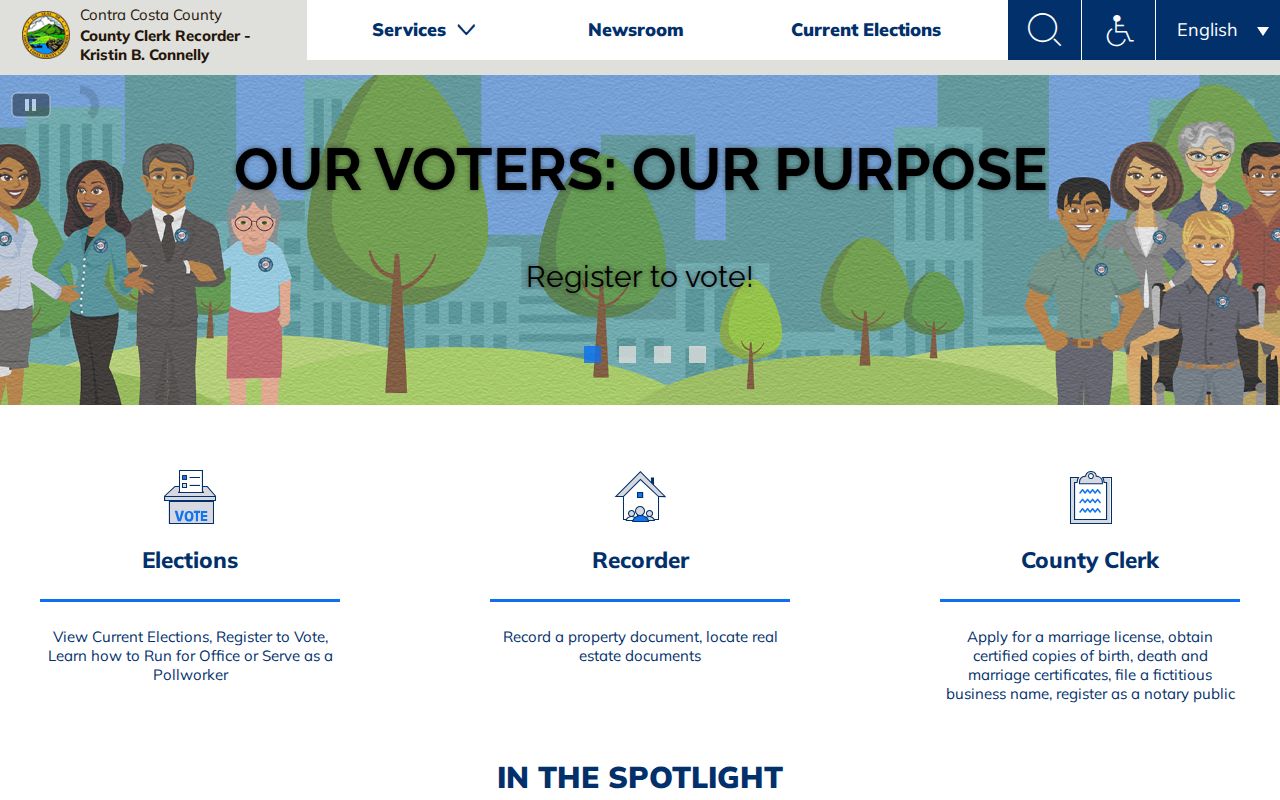
The screenshot belongs with the distinction between self-verification and a regulated data-file request. Neither route should be recast as a street-level household roster.
Note: A voter record can confirm a status for an authorized purpose, but it cannot be used to reconstruct a confidential residential address.
Following Contra Costa County Recorder Records
The Clerk-Recorder's official-record index is a name and document index, not an address directory. Start with an APN and the current assessed owner when the question begins at a parcel. Search that person as grantee to find the acquisition instrument, note the grantor, document type, recording date, instrument number, and legal description, then search the grantor as grantee in earlier years. Repeat only after matching the legal description or parcel lineage. A deed of trust is not the same as a conveyance.
Contra Costa recorded real-property records begin with county formation in 1850, but the online index and image reach must be checked in the live system. The public counter at 555 Escobar Street in Martinez provides a crucial fallback for older books, maps, and images. The office brochure says index searching and document viewing at the office are free; copies and certifications follow the current recorder fee schedule. Call 925-335-7900 to confirm coverage, book or film location, and ordering details.
- Roll
- A recurring official list, such as the assessment roll, that records a defined class of property or account fields.
- Index
- A finding aid organized by names, dates, document numbers, or other keys; it is not always the complete record image.
- Parcel
- A mapped unit of land identified by an APN, with geometry and assessment details that can bridge several record systems.
- Criss-cross directory
- A reverse directory arranged by street and number, allowing an address to lead to a listed subscriber or occupant for a stated year.
A certified deed or court file comes from the custodian. The recorder index is the trailhead, not proof that a named party currently lives at the parcel.
Matching a Contra Costa County Court Record
Contra Costa Superior Court covers civil, small claims, probate, family, juvenile, criminal, traffic, and related county trial-court records. The online case route is useful for case number, title, filing date, party names and roles, status, hearings, and register-of-action events. Civil and small-claims documents and minutes can be available for free download. Probate registers can be online while the underlying probate documents require a Court Records request. Limited unlawful-detainer matters may require a clerk call or counter request.
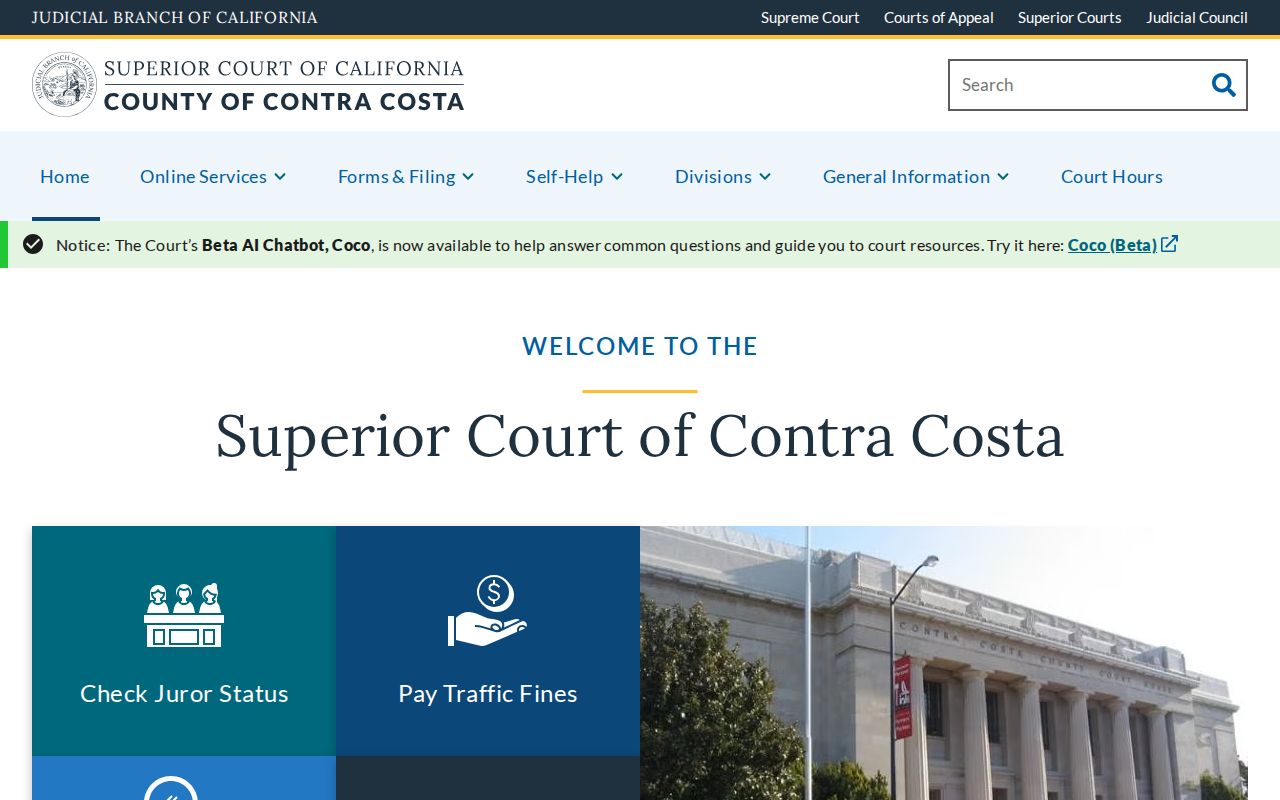
The court image reinforces the need to use the correct division and access route instead of treating one portal screen as a complete court history.
Same-name results need a second anchor. Compare the case number, filing date, party role, middle name, counsel, property or APN reference, and disposition. A criminal filing is not a finding of guilt, and a case status is not the same as the allegations in a complaint. Sealed, juvenile, adoption, and protected filings stay outside ordinary remote access. Court copies are obtained from the clerk, with current fees for pages, certification, and longer file searches.
Federal matters are separate. A Contra Costa party may appear in the Northern District of California and PACER, while bankruptcy matters sit in the federal bankruptcy system. Those records should be searched only when the known fact points to federal court.
Contra Costa County Vital Records and Copies
The County Clerk-Recorder is the local source for Contra Costa birth, death, and marriage copies, while Contra Costa Health handles local registration for recent events and the California Department of Public Health maintains statewide vital records. A divorce decree belongs to Superior Court; a CDPH dissolution certificate is a narrower certificate of record, not the full decree. This split matters when a resident lookup needs an event date rather than a complete legal file.
The state uses authorized and informational certified copies instead of a single rule that opens every record after a set number of years. An authorized copy can establish identity. An informational copy carries the legend that it is not valid to establish identity and may redact protected material. Mail requests for authorized birth, death, and marriage copies require the sworn statement and notarization. Confidential marriage records are limited to the parties or a court order. Adoption records and confidential birth sections have their own restrictions.
California Vital Records ordering guidance supplies the current form, eligibility, fee, and processing instructions. The 2026 state schedule lists $31 for a birth copy, $26 for a death copy, $19 for a public or confidential marriage copy where applicable, and $18 for a dissolution certificate. Fees, forms, and processing times should be checked before mailing. A certificate of no public record is issued when a CDPH search finds no record.
Note: An index or obituary can suggest an event, while only the eligible custodian can issue the certified copy that proves it.
Comparing Contra Costa County Directory Sources
Compiled people directories gather public filings, licensed data, and inferred connections into a convenient result. They can be useful as a lead, but they may merge same-name records, repeat an old address, or label a former co-address user as a current connection. An official record is narrower and often less convenient, yet its custodian, date, record type, and access rule are visible.
A careful Contra Costa County residents directory search uses the compiled category, if at all, only to identify a record type to verify. It does not treat a paid result as a certified deed, court file, voter record, or vital certificate.
| Source type | Useful lead | What still needs verification |
|---|---|---|
| Assessor or recorder record | Parcel, owner-of-record, party role, document date | Current occupancy, same-name identity, complete deed image |
| Court or vital record | Case or life-event clue with a formal custodian | Access eligibility, sealed material, copy type, disposition |
| Library or historical collection | Past address, community, household, or family context | Publication date, omissions, original item, later changes |
| Compiled commercial listing | Possible record names, former address, or source hint | Every field against the originating agency or archive |
When Contra Costa County Records Stop Online
Online records are finding aids, and the next step depends on who created the record. For a county administrative record, the California Public Records Act allows a request for an identifiable existing record. Contra Costa requests may be oral or written at a counter, by email, U.S. mail, or fax. Name the department, record type, address or person, date range, and useful keywords. The normal CPRA response is a determination within ten days, not a promise that production will be complete in ten days. Inspection is generally free, while direct duplication costs may apply.
Contra Costa's public-record request portal is the online route for county requests outside a specialized office index.
The request portal image belongs with a precise request description, not a demand that an agency build a new resident profile.
Unincorporated building records use the County Conservation and Development ePermits pathway and the Building Records Research Request form. That form asks for requester contact details, property address, APN, record types, delivery choice, and authorization when protected plans are requested. Copy charges listed in the research are $0.10 per letter page and $0.20 per legal or 11-by-17 page, with a $1 minimum. An incomplete request can close after 30 days. Incorporated addresses go to the city that created the permit or code file.
The Clerk-Recorder counter, the Superior Court clerk, the correct city records officer, the County Library, CCCHS, and the State Archives each fill a different gap. A request should follow the record, not simply the postal city or the last portal visited.
Contra Costa County Library Record Paths
The Contra Costa County Library supplies the broadest local-history access layer across the county's communities. Its databases route researchers to Ancestry Library Edition for in-library use, HeritageQuest for library-card access, newspapers, obituaries, yearbooks, maps, and Local History Connection. Walnut Creek Library holds a large genealogy collection built from the county genealogical society's work, including family histories, church records, immigration material, military sources, and microform. Local History Connection is a free digitized collection, but its catalog and images are not a complete current nominal directory.
The Contra Costa County Library database list helps identify the right search route. Search a surname, street, town, business, and organization separately because a digitized item may be indexed by subject or creator rather than a person name.
The Contra Costa County Historical Society History Center at 724 Escobar Street in Martinez holds books and directories, early vital and cemetery indexes, city and town subject files, obituary and biography clippings, more than 1,700 maps dated from 1775 into the 1990s, yearly tax-assessor books stated as 1850-1910, court files from the 1850s into the twentieth century, and naturalization material. Its free PACT computer searches digitized photographs, newspapers, maps, histories, and the center database. Posted hours are Tuesday through Thursday, 9-4, and the first and third Saturdays, 10-2. Staff research is listed at $20 per hour for members and $30 for nonmembers. Verify hours and reproduction rules before travel.
The History Center collection and research pages are especially useful when a city website has no local directory and when a countywide trail crosses several communities.
Contra Costa County City Directory Geography
Contra Costa County contains 19 incorporated cities plus a large unincorporated population. Bay Point, El Sobrante, Kensington, Alamo, Discovery Bay, Rodeo, Crockett, North Richmond, Bethel Island, Byron, Knightsen, and other communities may have strong postal identities without being incorporated cities. That distinction changes the permit, code, police, and neighborhood custodian. It does not change the countywide Clerk-Recorder, Assessor, Elections, or Superior Court trail.
CCMap can help determine whether a parcel sits inside a city or in unincorporated county territory. A mailing line such as Martinez, Richmond, Concord, Walnut Creek, San Pablo, or Pittsburg is not by itself a city-limit test. The 2020 Census counted 1,165,927 county residents, so common-name searches and cross-city records need dates, roles, and parcel or case identifiers.
This geographic split is why a useful Contra Costa County residents directory starts countywide, then moves to the city or community that created the relevant local record. It also explains why a city permit search can fail while the county land and deed trail remains available.
Contra Costa County Business Record Trails
Professional and business records can separate people with common names by showing a license number, entity number, filing date, board, agent, or public business address. They establish an affiliation or filing role, not a home address. Use the board that issued the credential and the Secretary of State record that created the entity, then compare dates and roles with a parcel or court record if the research question calls for it.
California's Department of Consumer Affairs license search is the official starting point for board, license type, license number, name, city, county, or ZIP fields where a selected board exposes them.
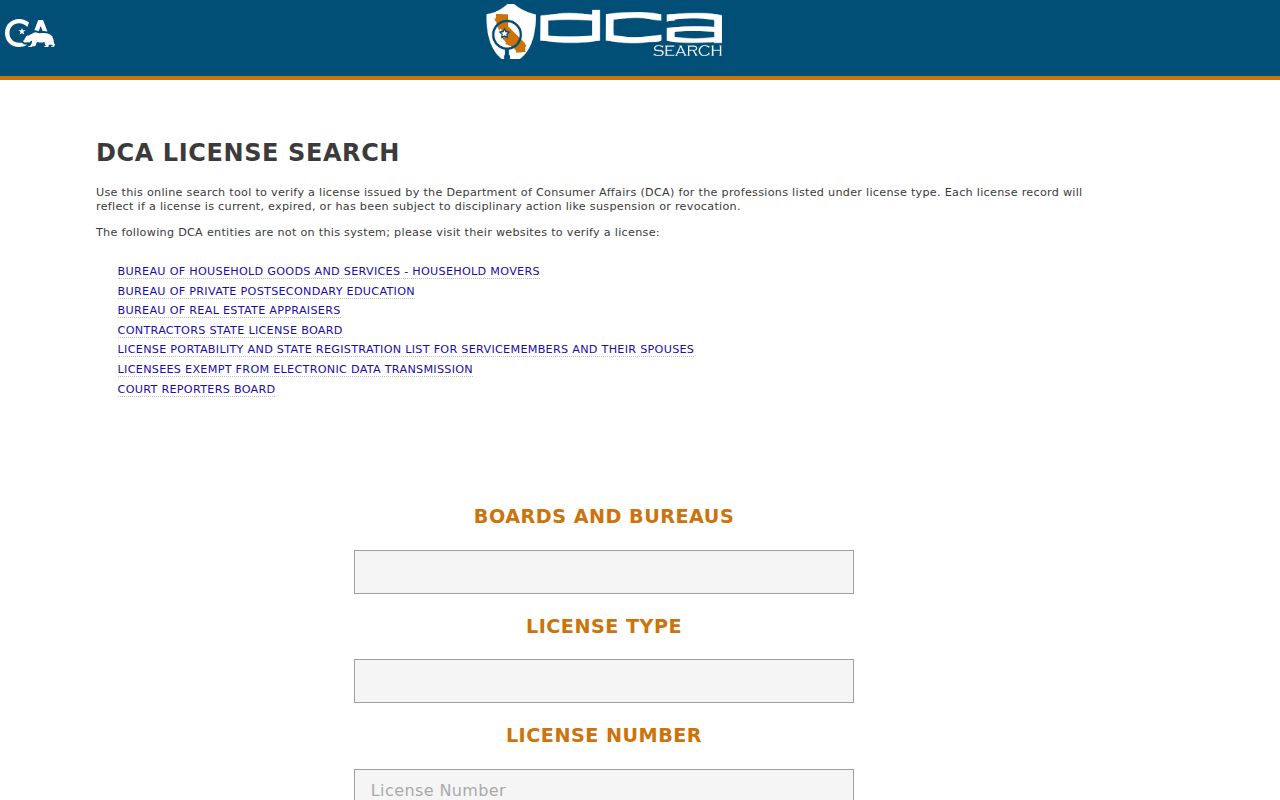
The license-search image illustrates why the board and license type matter: search fields and public address detail vary by profession.
The California Secretary of State business search supports business-name or entity-number research. Results can show entity name and number, registration date, status, jurisdiction, principal or mailing address, agent for service, and available filings. A filing address belongs to the role listed in the document and should not be turned into a residence claim.
The business-search image fits an affiliation trail that can be checked against a county fictitious-business-name filing or a city license, not a household assumption.
Contra Costa County Resident Privacy
California's privacy rules shape what a Contra Costa County residents directory can responsibly report. Safe at Home gives eligible survivors and other covered participants a substitute mailing address for public-facing government interactions. Government Code sections 6205-6211 protect the program, but it cannot retroactively erase a record already made public. A protected address should never be reconstructed from another field, a parcel map, or a voter-file guess. The correct response is to respect the custodian's redaction and confidentiality process.
The state also launched DROP, the Delete Request and Opt-out Platform, on January 1, 2026. California residents verify residency through the state identity route, submit identifiers such as name, birth date, ZIP, email, phone, VIN, or advertising ID, and receive an eight-digit request ID. Registered data brokers begin retrieving requests August 1, 2026, with a statutory processing cycle of at least 45 days. A DROP request concerns commercial broker copies, not the county's own lawful records.
California DROP information explains the new deletion route and status process.
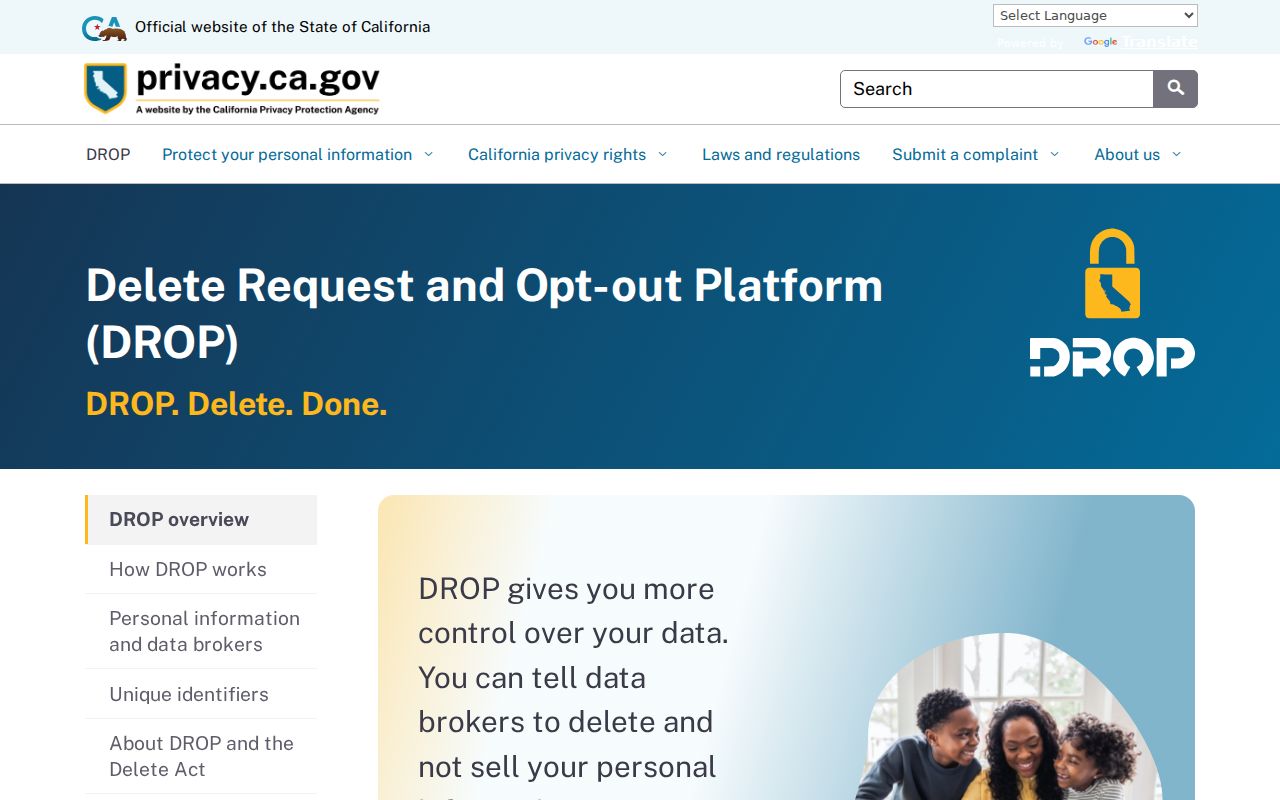
The DROP image belongs with a privacy choice: remove a commercial copy through the state or its own opt-out path, while corrections to a government record go to the agency that created it.
Lawful personal use. Public records are for legitimate research, family history, civic understanding, and property questions. California stalking, criminal-threat, and repeated-harassment laws still apply, and no record should be used to stalk, harass, intimidate, or harm a person.
Earlier Contra Costa County Resident Directories
Contra Costa's historical directory market is split by territory. The Richmond Museum of History and Culture finding guide begins with a 1903 Pacific States Telephone and Telegraph book, lists Richmond Directory Publishing volumes for 1907 and 1908, a 1909-1910 Northwestern Pacific Railroad directory, and R. L. Polk volumes from 1910-1911 through a last listed Richmond volume in 1964-1965. Telephone books continue in the inventory through 2015-2016, with real gaps. Richmond, Martinez, Antioch, Pittsburg, and nearby communities do not share one uninterrupted county book.
A 1914-1915 Polk entry may show a surname, given name or initials, spouse in parentheses, occupation, employer, residence marker, street address, boarding or householder mark, and widow notation. A reverse street section, when present, can move from a house number to a listed subscriber or occupant. The 1911-1912 territory includes Pullman, San Pablo, and Stege; a 1922-1923 guide labels El Cerrito as Rust. Historic place names belong in the search plan.
The Contra Costa County city directory page carries the detailed collection, entry-reading, and household-tracing treatment. The home-level residents directory should hand off the historical shelf rather than recreate every volume here.
Note: A directory entry dates a listed person to a publication and canvass period; it does not prove ownership, a complete household, or continuous residence.