
The Contra Costa County City Directory Shelf
Contra Costa County has separate local directory territories, not a single shelf. The Richmond Museum of History & Culture finding guide is unusually exact about territory, publisher, physical volume, and copy count. Its western-county run begins with a 1903 Pacific States Telephone & Telegraph book, then the Richmond Directory Publishing volumes, a Northwestern Pacific Railroad directory, and the R. L. Polk series. The table keeps real gaps visible so a missing year is not mistaken for a missing household.
| Collection | Years | Where Held | Access |
|---|---|---|---|
| Pacific States Telephone & Telegraph, Alameda and Contra Costa | 1903 | Richmond Museum finding guide | Consult the guide; volume access is in person |
| Richmond Directory Publishing Co. | 1907-1908 | Richmond Museum of History & Culture | In person from the museum holding |
| Northwestern Pacific Railroad directory | 1909-1910 | Richmond Museum of History & Culture | In person from the museum holding |
| R. L. Polk Richmond and Contra Costa directories | 1910-1918 | Richmond Museum; 1914-1915 also digitized in catalogs | Museum access plus selected digital copies |
| Western Directory and Polk Richmond run | 1920-1942, with gaps | Richmond Museum; Oakland Public Library lists selected Polk years | Finding guide, in-person shelves, and selected catalogs |
| Polk postwar Richmond volumes | 1947-1948 through 1964-1965, with gaps | Richmond Museum; selected library and FamilySearch catalogs | Check the holding and access icon before travel |
| Contra Costa and west-county telephone books | 1913 through 2015-2016, discontinuous | Richmond Museum; selected Library of Congress scans | In person, with some digitized books |
| East-county Pittsburg, Antioch, and Brentwood items | 1937, 1947, 1949, 1952, 1954-1955, 1960; Antioch 1952/1954; Brentwood 1954-1957 | FamilySearch catalog and in-library Ancestry | Confirm the film or item access before a visit |
The largest span is an inventory of holdings, not proof of annual publication. The 1920s through 1964-1965 contain gaps, and telephone volumes continue through 2015-2016 with missing years. A date range should therefore be read as a map of what may be found, not as a claim that every edition survived.
Contra Costa Multi-City Directory Shelf
Richmond and the western shoreline have the deepest continuous run. Martinez, Antioch, Pittsburg, West Pittsburg, Shore Acres, and Brentwood appear in different editions or catalog records. A search that uses only a modern municipal name can miss a volume filed under an older community or a telephone territory. The 1911-1912 Polk book includes Pullman, San Pablo, and Stege. A later Western guide adds El Cerrito, while the 1922-1923 guide labels El Cerrito as Rust. Historic place names belong in the search plan.
The county library and historical society fill different gaps. Walnut Creek Library houses a large genealogy collection with books, pamphlets, periodicals, microform, family histories, military and immigration material, church records, and regional genealogy. Ancestry Library Edition is available inside library locations without a card, while HeritageQuest adds census and family-history material. These resources help locate a title or image, but a catalog entry is not a complete nominal roll.
The Contra Costa County Library genealogy database page is the best first view of its licensed and local-history layer.
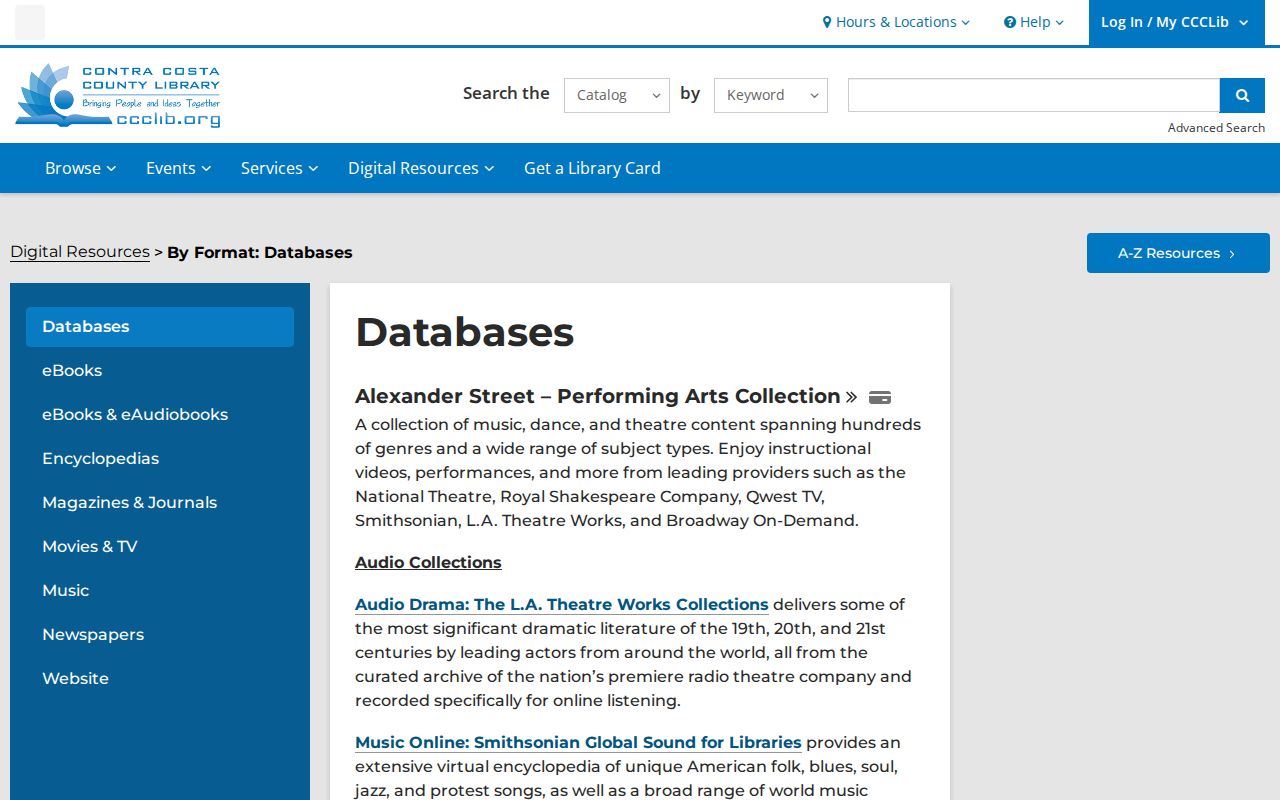
The library layer joins digitized images to census, church, court, and immigration sources, which makes a city directory more useful as a dated clue than as a stand-alone answer.
Where Contra Costa County Directories Live
The Contra Costa County Historical Society History Center at 724 Escobar Street in Martinez holds books and directories, early vital and cemetery indexes, city and town subject files, a large obituary and biography clipping file, maps, assessment books, court material, and naturalization records. Its collection page reports more than 1,700 maps dated from 1775 into the 1990s, yearly tax-assessor books stated as 1850-1910, and court files from the 1850s into the mid-twentieth century.
The History Center's PACT public-access computer is free and searches digitized photographs, nineteenth-century newspapers, maps, county histories, Nilda Rego columns, and the center database. Staff research is available for personal use at $20 per hour for members or $30 per hour for nonmembers. Posted hours are Tuesday through Thursday, 9-4, and the first and third Saturdays, 10-2. Call 925-229-1042 or email info@cocohistory.org, and verify hours before travel.
The Contra Costa County Historical Society collections page shows why a directory request may need an assessor book, map, obituary file, or court index beside the volume itself.
That broader shelf is especially useful when a directory entry gives a name and street but no clear answer about a move, death, or connection to a parcel.
Note: A catalog entry identifies a holding or image, while the repository controls the volume, reproduction terms, and reading access.
Richmond Directory Years in Contra Costa
The Richmond Museum finding guide identifies a 1903 telephone volume, Richmond Directory Publishing books for 1907 and 1908, the 1909-1910 railroad directory, Polk books from 1910-1918, Western and Polk editions in the 1920s through 1942, and postwar Polk volumes through 1964-1965. It also lists telephone books for 1913, 1914, 1925, 1934-1935, 1940-1941, 1943, 1945, 1947, 1949, 1955, 1961-1965, and 1967-1969.
Later west-county telephone holdings include 1970, 1972, 1974-1985, 1987, 1992-1997, 2001-2002, 2006, 2006-2007, and 2009-2016. The gaps are part of the evidence. A missing 1919 or 1931 volume cannot be treated as a year with no resident. Search the closest prior and next edition, then use newspapers, census schedules, yearbooks, or a deed to bridge it.
Note: A volume date identifies the edition, not necessarily the day its canvass reached a particular Contra Costa County street.
Reading a Contra Costa Directory Entry
The 1914-1915 R. L. Polk & Co.'s Richmond and Contra Costa County Directory separates an alphabetical resident and business section from classified advertising and street material. Copy the title page, publication date, abbreviation key, and full entry before drawing conclusions. The printed date is a title and coverage clue, not proof of the exact day a person was visited or the length of a stay.
| Name | Surname with given name or initials; early entries may subordinate a married woman's name to her spouse. |
|---|---|
| Spouse | Later Polk conventions often place a spouse's given name in parentheses. |
| Occupation | Historical occupation and, in some editions, an employer abbreviation, useful for distinguishing same-name entries. |
| Residence | Street address with r or res for residence; b can mark boarding, and h may mark a home where the legend defines it. |
| Widow marker | wid followed by a deceased spouse's given name can narrow a death between editions. |
| Reverse section | A street-order section may list numbers and occupants, but it is not present or complete in every volume. |
- Criss-cross directory
- An address-first or street-order section used to move from a street number to a named occupant or business.
- Householder index
- A name or household finding aid that points to the main entry; it does not guarantee that every member of a household appears.
- Abbreviation key
- The volume's legend for marks such as r, res, b, and wid. Photograph or transcribe it before reading entries.
A directory does not prove legal ownership, a complete household, or continuous residence through the full cover year. People who declined canvassing, children, new arrivals, and non-subscribers may be absent.
Contra Costa Local History Connection Directories
The library's Local History Connection is a free CONTENTdm collection built from the library and participating historical societies and museums. Its keyword and browse tools can surface photographs, documents, ephemera, places, dates, and contributing institutions. Search a surname, street, business, and town as separate terms. A result's creator, date, subject, and place may point to a physical collection even when the image is online.
The Local History Connection collection is a digitized catalog and image source, not a complete Contra Costa County city directory. Use its metadata to learn which institution holds the next item, then ask about donor limits, reproduction rules, or an uncataloged volume.
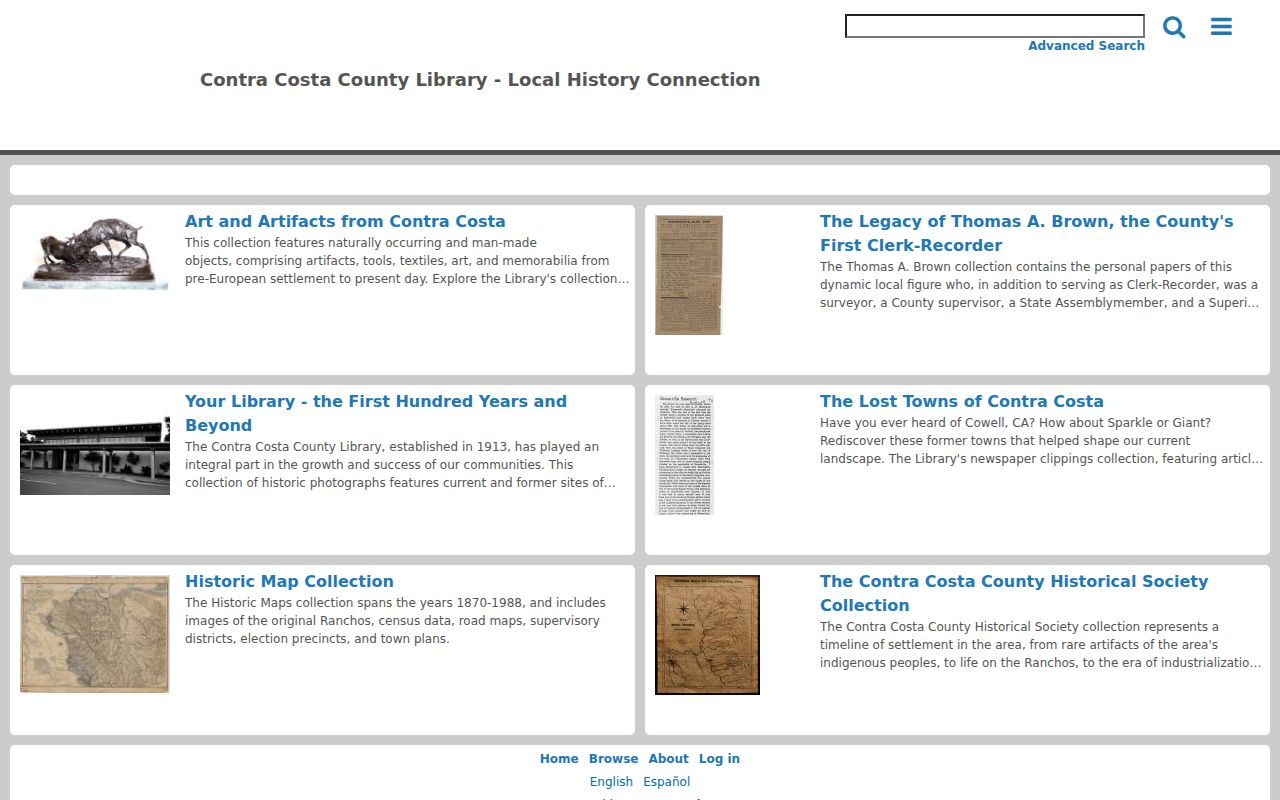
That handoff from a digital item to a named repository often solves a gap that a broad web search leaves unexplained.
Contra Costa County Newspapers Fill Directory Gaps
The library's historical newspaper holdings identify exact runs for the Antioch Ledger, Contra Costa Gazette, and Richmond Daily Independent. The Antioch Ledger has online portions from 1870-1872, 1877-1880, scattered 1884-1890, and April 1890 through December 1923. The Contra Costa Gazette has online material from May 1860 through December 1900 and January 1905 through December 1922. Richmond Daily Independent material covers June 1910 through October 1920 and December 1920 through December 1922. Film and paper gaps remain.
Search legal notices, society columns, school news, obituaries, property transfers, and business notices around the missing directory year. Yearbooks, church records, cemetery registers, and family-history collections add names that a city directory may omit. The library notes that its later obituary database covers Contra Costa Times material from June 1995 forward, while earlier Times obituaries are on microfilm and staff do not conduct obituary searches.
The Contra Costa County Library newspaper holdings page is the source for the online, film, and paper split.
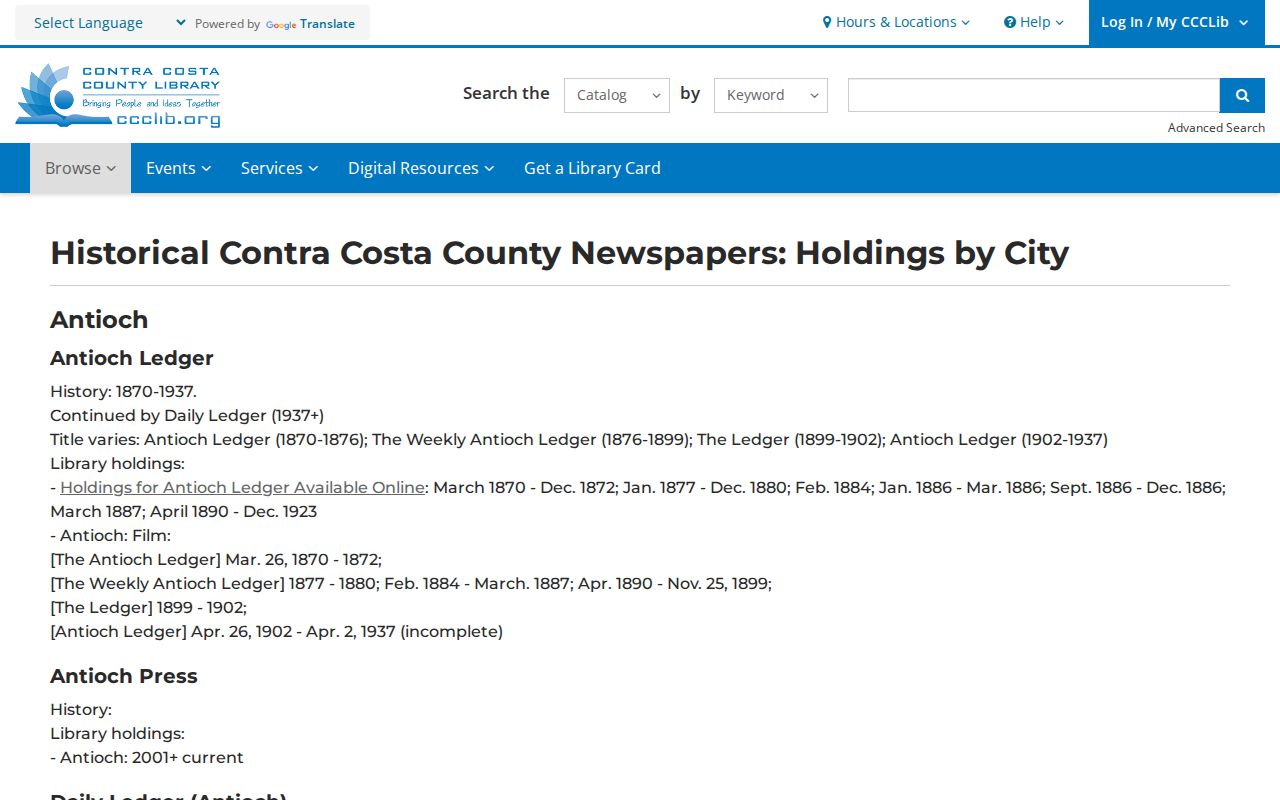
Newspaper evidence can supply the date of a death, move, sale, marriage, or public event that explains why a name changes between two directory editions.
Richmond Shipbuilding and Contra Costa County Records
Richmond's wartime shipbuilding migration left a different archival pattern from later subdivision growth in central and eastern Contra Costa County. A person may appear briefly in a directory, then surface in a newspaper, school annual, shipyard-related collection, church record, or federal file. The absence of a name from one annual volume is not enough to erase that connection.
Use the directory address and occupation as a lead, not as a full biography. Compare the street entry with the alphabetical entry, then check a dated newspaper or yearbook. The History Center's maps, clippings, and local database can anchor the community, while the Online Archive of California can locate a manuscript or organizational finding aid held elsewhere.
Note: Local industry, migration, and annexation can change a directory's territory without changing the underlying household history.
Tracing Families Through Contra Costa County Directories
Start with a known name and year, then copy the whole entry. Keep the address, spouse, occupation, widow notation, abbreviations, and any business line together. The sequence below pairs the historical directory with the county's other dated sources.
- Find the first appearance in the best matching Richmond, Martinez, Pittsburg, Antioch, or telephone edition.
- Search the preceding and following editions for the surname, spouse, street, and nearby community names.
- Use the reverse or criss-cross section, when present, to test the address and identify the next occupant.
- Pair observations with the 1850, 1860, 1870, 1880, 1900, 1910, 1920, 1930, 1940, and 1950 federal census schedules.
- Close a missing-year trail with newspapers, yearbooks, cemetery material, probate, or the CCCHS obituary and biography files.
The Census Bureau's 72-year rule means 1950 is the newest public population census in the current research set, while 1960 is scheduled to open in 2032. A census can show household composition and relationships that a volume leaves out; the directory can bridge the ten-year census gaps.
When a Contra Costa Directory Entry Disappears
Disappearance has several possible meanings: a move, death, a changed surname, a new community heading, a missed canvass, or a volume gap. Search the next edition under the spouse, widow marker, business name, and old street label. The 1922-1923 use of Rust for El Cerrito is a reminder that a place-name change can mimic a resident's move.
For a broader finding-aid search, use the Online Archive of California. Its repository-level descriptions can locate family, church, club, union, school, and community collections before a visit. The archive search is a locator, just as the directory index is a locator; the holding repository supplies the underlying item and its access terms.
The best final entry is a source-linked, dated comparison of independent records, with each gap and uncertainty left visible.
Note: A directory clue becomes stronger when its name, date, address, and community match an independent newspaper, census, map, or probate record.